Waiting on Washington: How Federal Lease Uncertainty Is Forcing a Rethink of Upstream Capital Timelines

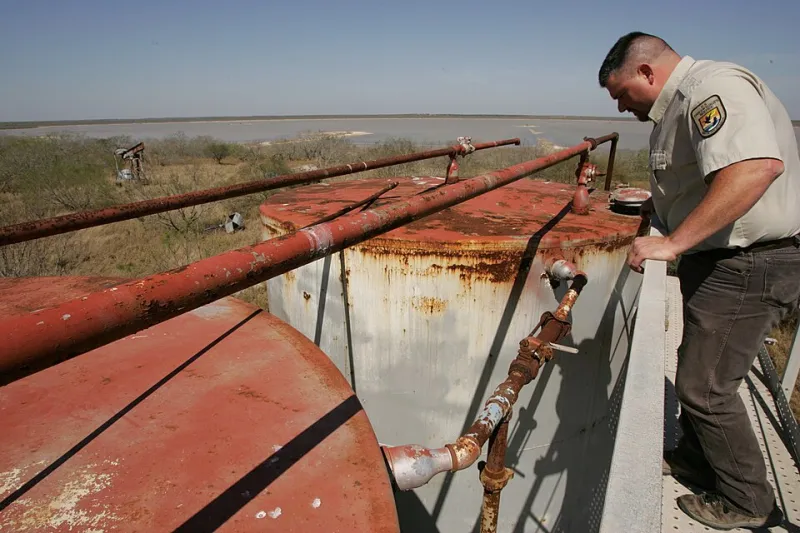
Photo: David Hiser, Public domain, via Wikimedia Commons
For decades, federal lease sales operated as a dependable, if imperfect, mechanism for translating government acreage into commercial opportunity. Operators could plan around quarterly schedules, model bid economics with reasonable confidence, and move capital into development pipelines on timelines that reflected geology and engineering — not administrative calendars. That assumption no longer holds. What has emerged in its place is a permitting environment defined less by regulatory process than by unpredictability, and the business consequences are beginning to register in measurable ways across the upstream sector.
The Anatomy of a Delayed Cycle
Federal onshore and offshore lease sales in the United States are governed by a framework that, in theory, provides structured intervals for acreage access. In practice, that framework has become increasingly susceptible to disruption. Court injunctions challenging the legal basis of individual sales, environmental review extensions, administrative reconsideration periods, and outright policy-driven moratoriums have collectively eroded the predictability operators once relied upon.
The Bureau of Land Management's onshore program and the Bureau of Ocean Energy Management's offshore schedule have both experienced significant timeline compression and postponement in recent years. Some sales have been challenged in federal court before the ink dried on final notices. Others were delayed during interagency review processes that stretched well beyond statutory expectations. The cumulative effect is a lease sale calendar that functions less like a schedule and more like a probability distribution — one with a frustratingly wide range of outcomes.
For capital planning purposes, this distinction matters enormously. Upstream investment decisions, particularly those involving exploration acreage, require lead times that can span two to four years from initial budget commitment to first meaningful geological data. When the availability of the acreage itself is uncertain, that entire planning sequence becomes conditional — and conditional capital is often deferred capital.
Budget Allocation in an Era of Administrative Risk
The response from operators has not been uniform, but several patterns have emerged with enough consistency to warrant attention. Among large independents and integrated majors with federal exposure, exploration budget line items have increasingly been restructured to account for what internal planning teams are now treating as administrative risk — a category that did not formally exist in most capital allocation frameworks ten years ago.
This restructuring takes several forms. Some operators have extended their pre-bid evaluation windows, absorbing higher front-end technical costs in exchange for greater flexibility to redirect capital if a sale is postponed or invalidated. Others have introduced explicit contingency reserves within exploration budgets, effectively self-insuring against the cost of mobilizing evaluation teams for sales that ultimately do not occur on schedule.
Perhaps most significantly, a segment of the operator community has begun discounting expected returns on federal acreage to reflect the time-value cost of administrative delays. A lease block that would generate an acceptable internal rate of return under a 24-month development timeline may not clear the same hurdle at 36 or 42 months — particularly in a higher interest rate environment where the cost of carrying deferred capital has risen materially.
The State Acreage Arbitrage
One of the more consequential byproducts of federal lease uncertainty has been the acceleration of capital toward state-administered and private acreage. Operators with the portfolio flexibility to reallocate exploration spending have increasingly done so, directing capital toward jurisdictions where permitting timelines are more predictable, even when the underlying geology is comparatively less prospective.
This is a rational response to administrative risk, but it carries its own set of implications. State programs in Texas, Oklahoma, and North Dakota have absorbed portions of the capital that might otherwise have flowed into federal programs, contributing to activity levels in those basins that may not be fully explained by commodity price signals alone. Conversely, federal acreage in Wyoming, New Mexico, and the Gulf of Mexico has seen exploration interest that, in some cases, reflects a smaller bidder pool than historical participation rates would suggest.
The competitive dynamics within lease sales themselves have also shifted. When the pool of active bidders contracts — either because operators have redirected capital elsewhere or because uncertainty has elevated the perceived risk of participation — the distribution of acreage increasingly favors operators with the balance sheet strength to absorb administrative delays without material impact on their broader programs. Smaller independents, for whom a single delayed or invalidated lease sale can represent a meaningful disruption to annual capital deployment, are disproportionately affected.
Portfolio Geography as a Strategic Variable
The operators who have navigated this environment most effectively share a common characteristic: geographic diversification that was deliberately structured to reduce dependence on any single regulatory jurisdiction. This is not a new concept in upstream portfolio management, but the federal permitting environment has elevated it from a general risk management principle to a specific competitive advantage.
Companies with meaningful exposure to both federal and non-federal acreage across multiple basins retain the ability to reallocate capital within a given budget cycle when federal timelines slip. Those concentrated in a single federal program — whether Gulf of Mexico deepwater or a specific onshore basin with high federal land concentration — have fewer levers to pull when administrative delays compress their operational windows.
This dynamic is beginning to influence acreage acquisition strategy prospectively, not just reactively. Due diligence processes for portfolio acquisitions now routinely include assessments of regulatory jurisdiction mix, and the implied discount applied to federal acreage packages has widened in some transaction discussions to reflect the incremental administrative risk embedded in those assets.
What Stabilization Would Require
The structural factors driving federal lease uncertainty are not easily resolved. They reflect a combination of litigation risk that is inherent to any administratively intensive process, genuine policy disagreement between successive administrations, and statutory frameworks that were not designed to accommodate the volume and complexity of contemporary legal challenges.
Meaningful stabilization of federal lease sale timelines would likely require both legislative clarification of the legal standards governing lease program design and a more durable administrative consensus around the pace and scope of federal acreage access. Neither condition is imminent. In the absence of that stabilization, the upstream sector will continue adapting — through portfolio repositioning, budget restructuring, and the quiet repricing of federal acreage risk that is already underway in capital allocation decisions across the industry.
For industry professionals tracking upstream investment flows, the federal permitting environment represents one of the more consequential structural variables currently shaping where and when exploration capital moves. The lease sale calendar may belong to Washington, but the capital allocation decisions it disrupts belong to the market — and the market is adjusting accordingly.