Reserves on Paper, Wells in Waiting: The Widening Gap Between Reported Assets and Commercial Reality

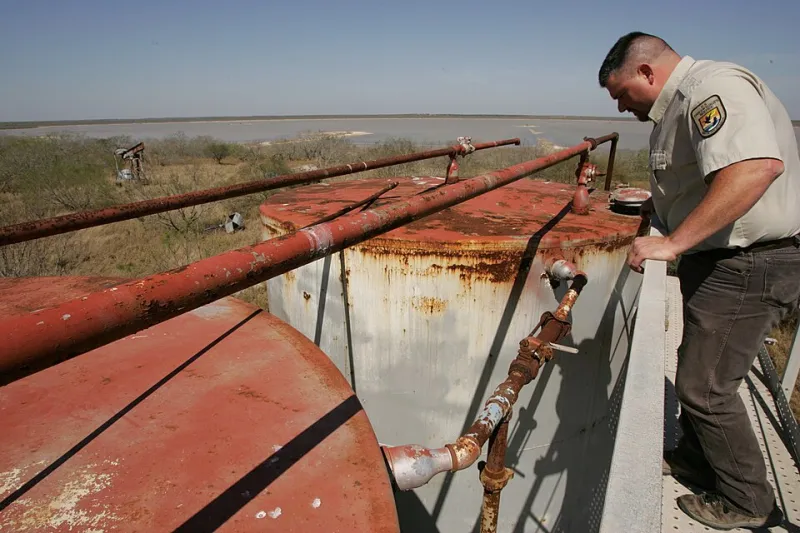
Photo: Kun Kipcsak, CC BY-SA 4.0, via Wikimedia Commons
For decades, proved reserves have functioned as the upstream petroleum industry's most closely watched balance sheet entry — a number that ostensibly tells investors how much recoverable hydrocarbons a company controls and, by extension, how much future cash flow it can generate. Yet a careful reading of SEC filings, production data, and capital allocation patterns across US operators reveals a more complicated picture. The gap between what companies report as proved reserves and what they can realistically extract within a commercially viable timeframe has widened considerably, raising substantive questions about the integrity of upstream valuations and the strategic assumptions embedded in corporate planning.
The Regulatory Framework and Its Built-In Tensions
Under SEC Rule 4-10(a), proved reserves are defined as quantities of oil and gas that can be estimated with reasonable certainty to be economically producible under existing economic conditions, operating methods, and government regulations. The phrase "existing economic conditions" is where the complexity begins. The SEC mandates use of a twelve-month average price — calculated from the first-day-of-the-month price for each month in the prior year — rather than a forward price curve or a company's internal commodity forecast.
This backward-looking pricing mechanism introduces a structural lag. When commodity prices are elevated, as they were through much of 2022, operators are permitted to book reserves that would be uneconomic at lower price points. Conversely, price downturns trigger reserve write-downs that can appear sudden and severe to outside observers, even when the underlying geology has not changed. The result is a reserve figure that reflects a regulatory snapshot rather than a probabilistic assessment of what will actually be produced and sold.
Beyond price assumptions, the SEC framework allows operators to classify proved undeveloped reserves — commonly referred to as PUDs — provided there is a documented plan to drill those locations within five years. This five-year development window is generous by any operational standard, and in practice, a substantial share of PUDs are never converted to producing wells within that horizon. Capital reallocation, asset divestitures, partner disputes, and shifting corporate priorities all intervene between the booking date and the drill bit.
Capital Discipline as a Structural Constraint
The shale era's early years were defined by aggressive reserve booking paired with equally aggressive spending. Operators drilled to hold acreage, satisfy lender covenants, and demonstrate growth to equity markets. That model collapsed under the weight of sustained low prices and investor fatigue between 2015 and 2020. The capital discipline that emerged from that period — reinforced by ESG pressure and shareholder demands for free cash flow — has fundamentally altered the relationship between booked reserves and actual development pace.
Today, many publicly traded US independents operate under explicit capital return frameworks that prioritize dividends and buybacks over drill-bit growth. In this environment, the internal rate of return threshold for sanctioning a new well has risen materially. Locations that technically qualify for proved reserve classification under SEC pricing assumptions may not clear the hurdle rate required for capital allocation approval in a given budget cycle. The reserve sits on the books; the well does not get drilled.
Private operators face a different but equally constraining dynamic. With private equity sponsors increasingly focused on monetization timelines and exit strategies, capital is directed toward near-term production enhancement rather than long-cycle reserve development. PUD inventories that might have attracted funding in a prior cycle now age on corporate registers without conversion.
The Three-to-Five-Year Development Lag in Practice
Field-level analysis of major US basins illustrates the development lag in concrete terms. In the Permian Delaware and Midland sub-basins, operators routinely carry PUD inventories representing eight to twelve years of drilling activity at current rig counts. In the Haynesville Shale, where natural gas price volatility has repeatedly disrupted development plans, PUD conversion rates have lagged booking rates for multiple consecutive reporting periods.
This lag is not inherently fraudulent or even misleading in a technical sense — operators are following established regulatory guidelines. But it does mean that investors relying on proved reserve totals as a proxy for near-term production capacity or net asset value are working with a figure that conflates what is geologically present with what is commercially imminent. The distinction matters enormously for valuation purposes, particularly as the cost of capital has risen and the tolerance for long-dated development projects has diminished.
Analysts at several institutional research desks have begun applying PUD conversion haircuts to their net asset value models — discounting undeveloped reserves by varying percentages based on historical conversion performance, balance sheet flexibility, and basin-specific infrastructure constraints. This practice, while not yet standardized, represents a growing acknowledgment that face-value reserve reporting requires interpretive adjustment.
Implications for Investor Valuation and Corporate Strategy
The reserve-to-production disconnect carries several practical implications for market participants. First, companies with large PUD inventories relative to their capital budgets may be systematically overstated on a net asset value basis, particularly if those reserves were booked during a high-price period that no longer reflects the current commodity environment. A rigorous valuation methodology requires stress-testing the development timeline against realistic capital availability and commodity price scenarios.
Second, the five-year PUD development requirement creates a recurring obligation that can generate regulatory friction. Companies that fail to develop booked locations within the mandated window must de-book those reserves, which can trigger negative market reactions disproportionate to the actual change in underlying asset quality. Investors who understand this dynamic can distinguish between a genuine deterioration in asset value and a technical accounting adjustment.
Third, for corporate strategists, the reserve-development gap has implications for M&A pricing. Acquirers who pay a premium for proved reserve totals without independently assessing development feasibility risk overpaying for assets that will require substantial additional capital before generating returns. Due diligence protocols increasingly include a granular review of PUD location economics, infrastructure access, and historical drilling performance — factors that do not appear in the headline reserve number.
Toward a More Transparent Reserve Discourse
The SEC's proved reserve framework was designed to establish a floor of standardization and comparability across a diverse industry. It largely achieves that objective. What it does not provide is a complete picture of the commercial trajectory of those reserves — when they will be developed, at what cost, and under what commodity price conditions.
For the investment community and the industry professionals who serve it, the most productive response is not to abandon proved reserves as a metric but to treat them as one input among several. Reserve replacement ratios, PUD conversion rates, development capital intensity, and free cash flow generation per barrel of production together paint a more accurate portrait of an operator's genuine productive capacity than any single balance sheet figure.
As capital discipline remains the governing philosophy across much of the US upstream sector, the distance between what is booked and what is drilled will continue to define the terrain that analysts, investors, and operators must navigate with increasing precision.