Terminal Pressure: The Real Price Coastal Communities Pay for America's LNG Export Ambitions
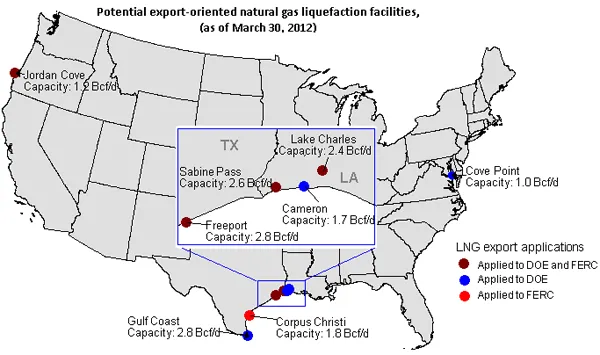
Photo: US Energy Information Administration, Public domain, via Wikimedia Commons
The United States crossed a significant threshold in 2023, surpassing Qatar and Australia to become the world's top exporter of liquefied natural gas. The milestone generated considerable industry enthusiasm and was cited as evidence of American energy dominance on the global stage. Yet for the communities situated along the Gulf Coast of Texas and Louisiana — as well as emerging project sites along the Atlantic seaboard — the ground-level reality of that achievement is considerably more nuanced.
Expansion of LNG export capacity requires massive onshore infrastructure: liquefaction trains, marine berths, pipeline interconnects, and industrial staging areas that transform quiet coastal zones into heavy industrial corridors. The economic benefits are genuine but unevenly distributed. The regulatory and environmental consequences, meanwhile, are concentrated in ways that national export statistics rarely capture.
The Infrastructure Footprint: Scale and Geography
As of mid-2024, the United States had six operational LNG export facilities, with several more in advanced stages of construction or regulatory review. The Sabine Pass and Corpus Christi terminals operated by Cheniere Energy represent the largest installed capacity, while projects such as Venture Global's Plaquemines LNG facility in Louisiana and the proposed Rio Grande LNG terminal in Brownsville, Texas, reflect the ongoing appetite for greenfield development.
The geographic concentration of these assets is notable. Roughly 70 percent of current and proposed US LNG export capacity sits within a 400-mile coastal arc spanning southeastern Texas through southern Louisiana. This corridor already hosts significant petrochemical and refining infrastructure, meaning communities in the region are layering new industrial burdens atop existing ones — a dynamic that local planning authorities and environmental advocates have increasingly flagged as a cumulative impact concern.
Project footprints are substantial. A single mid-scale LNG export terminal typically requires between 500 and 1,000 acres of coastal or near-coastal land, extensive dredging to accommodate LNG tanker drafts, and dedicated pipeline corridors stretching dozens of miles inland to reach natural gas supply networks. The engineering scale alone generates years of construction activity before a single cargo is ever loaded.
Regulatory Timelines and the Permitting Bottleneck
Federal approval for LNG export terminals involves multiple agencies, most prominently the Federal Energy Regulatory Commission (FERC) and the Department of Energy (DOE). The DOE authorization process distinguishes between exports to free trade agreement countries — which receive expedited review — and exports to non-FTA nations, which require a public interest determination. This bifurcation has become a source of strategic uncertainty for project developers.
In early 2024, the Biden administration announced a temporary pause on new DOE export approvals pending an updated economic and environmental review framework. The decision, which the administration characterized as a responsible recalibration, drew sharp criticism from industry groups and several Republican-led states that argued the pause undermined long-term supply agreements and investor confidence. The episode illustrated how quickly federal policy shifts can reverberate through project pipelines already years in development.
FERC environmental reviews, conducted under the National Environmental Policy Act, have also faced legal challenges from environmental organizations contending that cumulative greenhouse gas impacts are inadequately assessed. Several court rulings have remanded approvals back to the agency for additional analysis, contributing to the timeline uncertainty that now characterizes even well-capitalized projects.
For developers, average time from initial application to first LNG export has historically ranged from five to nine years — a window that carries substantial financing risk and requires locking in long-term offtake agreements with international buyers well before construction is complete.
Local Economic Impact: The Mixed Ledger
Proponents of LNG terminal development frequently cite job creation and local tax revenue as primary community benefits. These figures are real. Construction phases for large-scale terminals can employ thousands of workers, and operational phases generate stable, well-compensated positions in operations, maintenance, and logistics. Property tax contributions to local jurisdictions can be material, particularly in lower-income rural parishes and counties where industrial facilities represent a significant share of the tax base.
However, the distribution of those benefits is not uniform. Construction workforces are frequently sourced from specialized labor pools that travel with large industrial projects rather than hiring predominantly from surrounding communities. Local small businesses may see temporary increases in service demand during construction, but the transition to an operational facility typically supports a far smaller permanent workforce.
Fisheries and maritime industries — economically and culturally significant in Gulf Coast communities — face direct competition for waterway access and can experience disruptions from dredging, increased vessel traffic, and changes to coastal hydrology. In certain Louisiana parishes, longstanding commercial fishing families have documented declines in catch quality and access in areas adjacent to terminal construction zones, though establishing direct causal relationships within complex coastal ecosystems remains scientifically contested.
Environmental Concerns and the Community Advocacy Landscape
Environmental justice considerations have become increasingly prominent in LNG siting debates. Several proposed terminal locations are proximate to communities with large minority or low-income populations, raising questions about whether the geographic distribution of industrial risk reflects equitable decision-making processes. Advocacy organizations operating in the region have engaged both FERC proceedings and federal courts to press for more rigorous community impact assessments.
Air quality is a persistent concern. LNG facility operations involve combustion processes that emit nitrogen oxides and volatile organic compounds, and the associated pipeline compressor stations — often located miles inland — generate their own emissions profiles. For communities already navigating air quality challenges from existing petrochemical facilities, incremental additions to the pollution burden carry compounding public health implications.
Methane leakage across the LNG supply chain — from wellhead to liquefaction to shipping — has also drawn scrutiny from researchers and climate-focused policymakers. While LNG is frequently positioned as a cleaner alternative to coal for international buyers, lifecycle emissions analyses suggest the climate calculus depends heavily on leakage rates that vary considerably across operating conditions and infrastructure vintages.
What the Data Signals for Industry Stakeholders
For energy sector professionals monitoring this space, several dynamics merit close attention. First, the regulatory environment for new LNG export approvals is unlikely to stabilize quickly, regardless of which administration holds federal office. Legal challenges from environmental groups and policy reviews from successive administrations have introduced a structural layer of uncertainty that project economics must now accommodate.
Second, community relations have emerged as a genuine project execution risk, not merely a public affairs consideration. Permitting delays attributable to inadequate stakeholder engagement have added measurable costs to several Gulf Coast projects, and lenders and equity investors are increasingly scrutinizing social license to operate as a material factor in project bankability assessments.
Third, the long-term demand picture for US LNG — particularly in European markets reshaping their energy supply portfolios post-Ukraine — remains broadly supportive of continued investment. The question is not whether the US LNG sector will grow, but how effectively the industry and its regulatory partners can manage the distributional consequences of that growth in a manner that sustains public and political support.
The infrastructure required to make America the world's leading LNG exporter does not materialize in abstraction. It is built, piece by piece, on the coastlines where communities live and work — and the full cost of that buildout belongs in any honest accounting of the sector's performance.