Five Terminals Winning the Export Race — and Two Showing Cracks
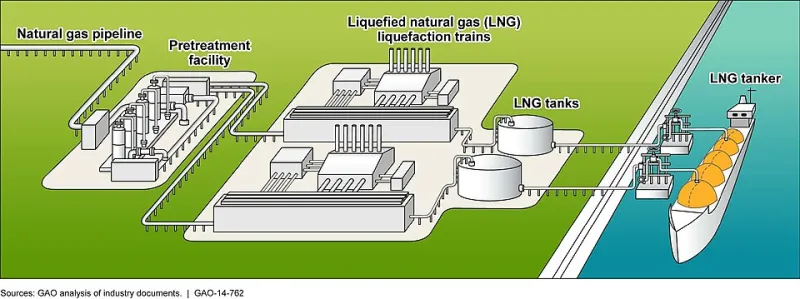
Photo: U.S. Government Accountability Office from Washington, DC, United States, Public domain, via Wikimedia Commons
The US Gulf Coast has become the hinge of global energy trade, and the terminals that move its cargo are no longer passive infrastructure — they are competitive weapons. But treating them as a monolith obscures a widening performance gap. Drawing on throughput data, announced capital programs, and committed contract backlogs, PetroMar Survey assessed the region's principal export facilities. The results separate genuine compounders from capacity that may arrive into a softer market than its sponsors hope.
How We Ranked Them
Three metrics drove the assessment: five-year compound throughput growth, committed expansion capital per barrel of daily capacity, and the share of future capacity already under long-term offtake. A terminal strong on all three is effectively pre-sold; a terminal weak on backlog is betting on spot demand in a volatile tanker market.
The Leaders
1. Corpus Christi complex, Texas. The South Texas LNG buildout remains the benchmark. Billions in expansion capital are anchored by decades-long offtake agreements with Asian and European buyers, and crude export berths alongside the gas facilities have posted double-digit annual throughput growth. Its constraint is not demand but the scale of concurrent construction — execution risk is the watchword.
2. Freeport, Texas. Anchored by one of the largest LNG export operations in the hemisphere and a deepwater crude terminal, Freeport benefits from diversified cargo mix. Its contract book is among the thickest on the coast, and barge-to-ship consolidation economics give it a durable cost advantage.
3. Sabine Pass / Cameron, Louisiana. The original LNG export hub continues to add trains and liquefaction capacity, with a backlog that stretches well into the next decade. Congestion in the Calcasieu Ship Channel remains a persistent operational friction point, but expansion projects are addressing it.
4. Houston Ship Channel / Texas City. The workhorse. Crude and refined product exports here grow steadily rather than spectacularly, but channel deepening and berth additions keep utilization high. Its exposure to refined product demand makes it more cyclical than the LNG-led leaders.
5. Plaquemines, Louisiana. The newest major entrant, with phased LNG capacity and a modern design footprint. Early commissioning performance will determine whether it earns a higher position in future rankings.
The Ones Showing Cracks
Greenfield crude-only terminals with thin backlogs. Several mid-size crude export projects on the upper Texas coast were financed on peak-cycle throughput assumptions. With OPEC+ supply dynamics shifting and Mediterranean and West African barrels competing for the same Atlantic Basin customers, spot-reliant facilities face utilization risk. Any terminal whose backlog coverage falls below roughly 60% of nameplate capacity deserves scrutiny.
Aging refined product terminals without expansion capital. Facilities that have deferred berth maintenance and dredging commitments are quietly losing draft clearance and loading speed relative to newer competition. In a tanker market where charter rates spike unpredictably, slow-turn terminals pay a real penalty.
The Takeaway for Market Watchers
The global trade shift — European demand for US gas, Asian appetite for light sweet crude, and growing Latin American refined product imports — rewards terminals with committed capacity and geographic flexibility. It punishes those financed on extrapolated spot demand.
For traders, the actionable signal is backlog coverage: capacity that is pre-sold is capacity that will be utilized regardless of the freight cycle. For investors, the differentiator is execution, not demand. On the Gulf Coast today, the question is not whether the cargo exists. It is whether the steel will be finished — and finished well — in time to handle it.